
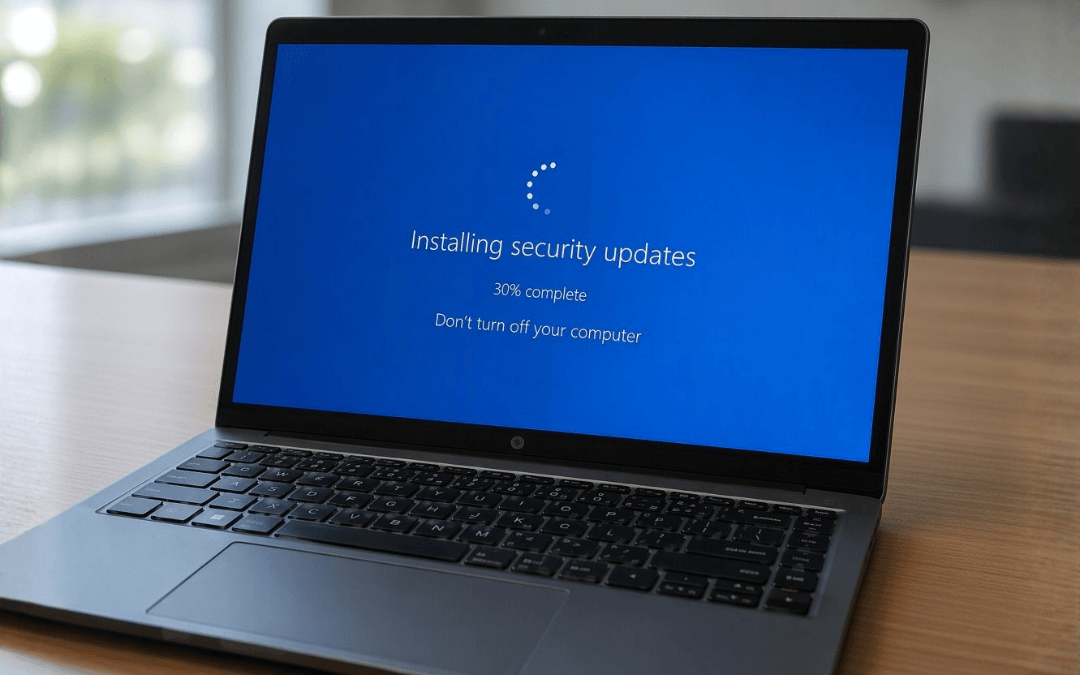
Microsoft Patch Tuesday just delivered the largest security release in the company’s history. If your business runs on Windows and Office—and most do—this one belongs on this week’s to-do list, not next month’s.
On October 13, Microsoft released security updates for a record-breaking 1,411 vulnerabilities as part of its Microsoft Patch Tuesday cycle. They include one zero-day attackers are already exploiting and two more that were publicly disclosed before a fix existed. The same day, Windows 11 version 24H2 Home and Pro reached end of support, so the October update is the last security patch those machines will ever receive.
What Happened
According to BleepingComputer’s breakdown, this month’s Microsoft Patch Tuesday release includes 70 vulnerabilities Microsoft rates “Critical.” Fifty-seven of those are remote code execution flaws, the kind that can let an attacker run their own code on a machine. Across every severity level, the fixes include 677 elevation-of-privilege bugs, 317 remote code execution bugs, 254 information disclosure bugs, and 40 security feature bypasses.
The flaw already being used in attacks, CVE-2026-96951, is a Windows Shell bug that lets attackers bypass Mark of the Web over a network. Mark of the Web is the warning Windows attaches to files downloaded from the internet, and it’s one of the last speed bumps between an employee and a malicious attachment. That makes a working bypass valuable to phishing crews. The two publicly disclosed zero-days are a .NET Framework flaw that could let an authenticated attacker get around Windows Defender Application Control and run unauthorized applications, and a denial-of-service bug in MessagePack-CSharp.
Microsoft says the record count reflects its growing use of AI to find and fix vulnerabilities in its own products. That’s good news in the long run. In the short run, it means more patches, more often, and more pressure on whoever handles updates at your company. This Microsoft Patch Tuesday underscores how quickly the volume of fixes can grow when automated discovery tools are applied at scale.
The End-of-Support Deadline Hiding in the Headlines
For small and midsize businesses, the quieter story may matter more. As of October 13, Windows 11 24H2 Home and Pro no longer receive monthly security updates. Microsoft is directing users to Windows 11 26H2, which is rolling out in phases. The Enterprise and Education editions of 24H2 remain supported until October 12, 2027.
Plenty of small businesses buy laptops with Windows 11 Pro and never think about feature versions again. Any of those machines still on 24H2 is now running without fixes for whatever Microsoft discovers from November on. Microsoft also reminded customers that Windows 11 23H2 Enterprise, Education, and IoT Enterprise editions will stop receiving security updates starting next month. Staying current after a major Microsoft Patch Tuesday is no longer optional for organizations that want to avoid unpatched exposure.
It’s Not Just Microsoft
October’s patch cycle also brought urgent fixes for products that sit at the edge of many business networks:
- An actively exploited zero-day in Ivanti Connect Secure
- A Citrix NetScaler flaw exploited before it was patched
- A critical FortiMail flaw exploited as a zero-day
- A maximum-severity SonicWall SMA1000 flaw that attackers began exploiting within two days of the fix
If your remote-access appliance or email gateway is on that list, it deserves the same urgency as your Windows fleet. Coordinating these updates alongside the Microsoft Patch Tuesday release is essential for comprehensive protection.
Why This Matters for Your Organization
Volume is now a security problem in its own right. When a single Microsoft Patch Tuesday brings more than 1,400 fixes, “we’ll get to it” becomes a backlog fast. We saw the same pattern in September’s WatchGuard ransomware alert, where thousands of devices stayed exposed months after a patch existed. The cause wasn’t a lack of awareness. Nobody clearly owned the process.
Unsupported doesn’t look broken. A Windows 11 Pro laptop on 24H2 will keep working normally. It just won’t be fixed against anything discovered from here on, and attackers know some businesses fall behind.
Prioritization beats panic. Microsoft is piloting a new way to group related vulnerabilities into “risk cohorts,” such as Office documents and mail clients, or Windows filesystems, storage, and backup, to help teams decide what to patch first. Microsoft calls the approach experimental and says it doesn’t replace its existing guidance. The underlying idea is still sound: start with what’s exploited, then what’s exposed, then everything else. Applying this mindset after every Microsoft Patch Tuesday helps keep the workload manageable.
What to Do This Week After Microsoft Patch Tuesday
- Find out what you’re running. Inventory Windows versions and editions on every company laptop and desktop. Move any Home or Pro machine still on 24H2 to a supported version.
- Patch the exploited zero-day first. Prioritize CVE-2026-96951, then Office and Outlook updates, since email and documents are where most attacks begin.
- Check your edge devices. If you run Ivanti Connect Secure, Citrix NetScaler, FortiMail, or SonicWall SMA1000, confirm the vendor’s fixed version is installed. “Updated recently” isn’t the same thing.
- Remind your team about downloads. Until every machine is patched, treat unexpected attachments and downloaded files with extra suspicion, because the warning Windows normally shows may not appear.
- Put a name on patching. Decide who owns updates, on what schedule, and how you’ll confirm they happened.
The Takeaway
Record patch counts are going to keep coming as vendors use AI to find bugs faster than ever. The businesses that handle each Microsoft Patch Tuesday well aren’t necessarily the ones with the biggest IT teams. They have a clear owner for patching, an accurate inventory, and a habit of checking that updates actually landed. October’s Microsoft Patch Tuesday is a good test of whether your business has all three.
Not sure whether your machines and edge devices are current? Black Belt Secure brings 20 years of experience to this kind of essential, unglamorous work. Schedule a free assessment with our team today, and we’ll show you where your patch gaps are before an attacker finds them.
Source: BleepingComputer, “Microsoft October 2026 Patch Tuesday fixes 1,411 flaws, 3 zero-days” (Lawrence Abrams, Oct 13, 2026); BleepingComputer, “Microsoft: Windows 11 24H2 Home and Pro reached end of support” (Sergiu Gatlan, Oct 13, 2026).